Why Fan Blade Design Matters: Airflow, Proportion and the Architecture of Movement
Walk into any well-designed room, and the ceiling fan rarely looks like an afterthought. That's not an accident. Fan blade design, which blends engineering and architecture, affects how a room feels, how quietly it cools, and how it sits within the room's proportions.
This guide breaks down what blade span, pitch, shape, and material actually do, and how to read those details before choosing a fan for your home.
Key Takeaways
- Span, pitch, shape, material, and blade count affect how much air a fan moves, not just aesthetics.
- Room proportions and ceiling height determine blade span size, which doesn't necessarily improve performance.
- Solid wood, ABS composite, and metal blades affect fan performance and feel.
- More blades doesn't mean more airflow. Three well-designed blades often outperform five poorly balanced ones.
- Blade design must consider airflow, motor power, and material durability in Dubai's climate.
What Actually Determines a Ceiling Fan's Airflow?
Several blade characteristics determine airflow, not a single spec-sheet number.
Here are their contributions.
Blade Span and Coverage
Blade span is the diameter the blades sweep as they rotate, and it's the single biggest factor in how much floor area a fan can effectively cool. A wider span moves air across a larger circle, but only if the motor is strong enough to drive it at a useful speed.
Blade Pitch (Angle)
Pitch is the angle at which each blade is set relative to the ceiling. A steeper pitch pushes more air per rotation, which is why higher-pitched blades often deliver stronger airflow even at the same blade span and motor speed.
Blade Shape and Curvature
Straight, flat blades move air differently to curved or tapered ones. Curved blades tend to move air more smoothly and quietly, while flatter blades can feel more direct but noisier at higher speeds.
Number of Blades
More blades doesn't automatically mean more airflow. Adding blades increases drag on the motor, so many well-engineered three- and four-blade fans outperform five- or six-blade designs that weren't built with the extra load in mind.
Motor Type and Speed
The blade only does what the motor allows it to. DC motors typically deliver stronger airflow per watt than older AC motors, and their finer speed control lets blade design translate into more usable, adjustable airflow rather than one fixed setting.
Blade Material: Why It Changes Both Performance and Feel
Material has a lot more effects on a fan than just how it looks. It changes the fan's weight, noise, motor load, and how it ages in your climate.
- Solid wood blades bring genuine warmth and texture to a room, and their natural density gives them a satisfying, substantial feel in motion, though they're best suited to indoor spaces away from direct moisture. A solid wood ceiling fan also tends to run a little quieter than composite alternatives, thanks to timber's natural vibration-dampening properties.
- The Gotland 132cm by Faro is a good example. Its walnut-finish blades show how a wider, mid-sized span and a natural material can work together for a standard living room or bedroom. These are the best ceiling fan blades.
- ABS composite blades are lighter, more consistent in shape, and hold up far better in humidity or direct outdoor exposure, which is why most wet-rated outdoor fans use them rather than modern wood ceiling fan.
- Metal blades, often aluminium, sit somewhere in between. Durable and modern-looking, with good resistance to warping, though they can transmit more vibration if not properly balanced.
Matching Blade Design to Room Proportion
Blade design only works if the fan is the right size for the room it's cooling. A fan that's too big for a small room feels too loud, and a fan that's too small for a large room barely moves the air.
As a general guide, smaller bedrooms and studies suit a blade span of 90–110cm, standard living rooms and bedrooms work well with something closer to 122–137cm, and larger open-plan or double-height spaces benefit from spans of 140cm and above.
If the room doubles as a reading or dining space, a ceiling fan Dubai with light lets the blade design double up as a lighting fixture rather than adding a separate one.
Blade Design for Outdoor and High-Airflow Needs
Outdoor areas like Dubai have different needs than indoor spaces when it comes to blade design. Heat, humidity, and dust put extra stress on both the blade and the motor that drives it.
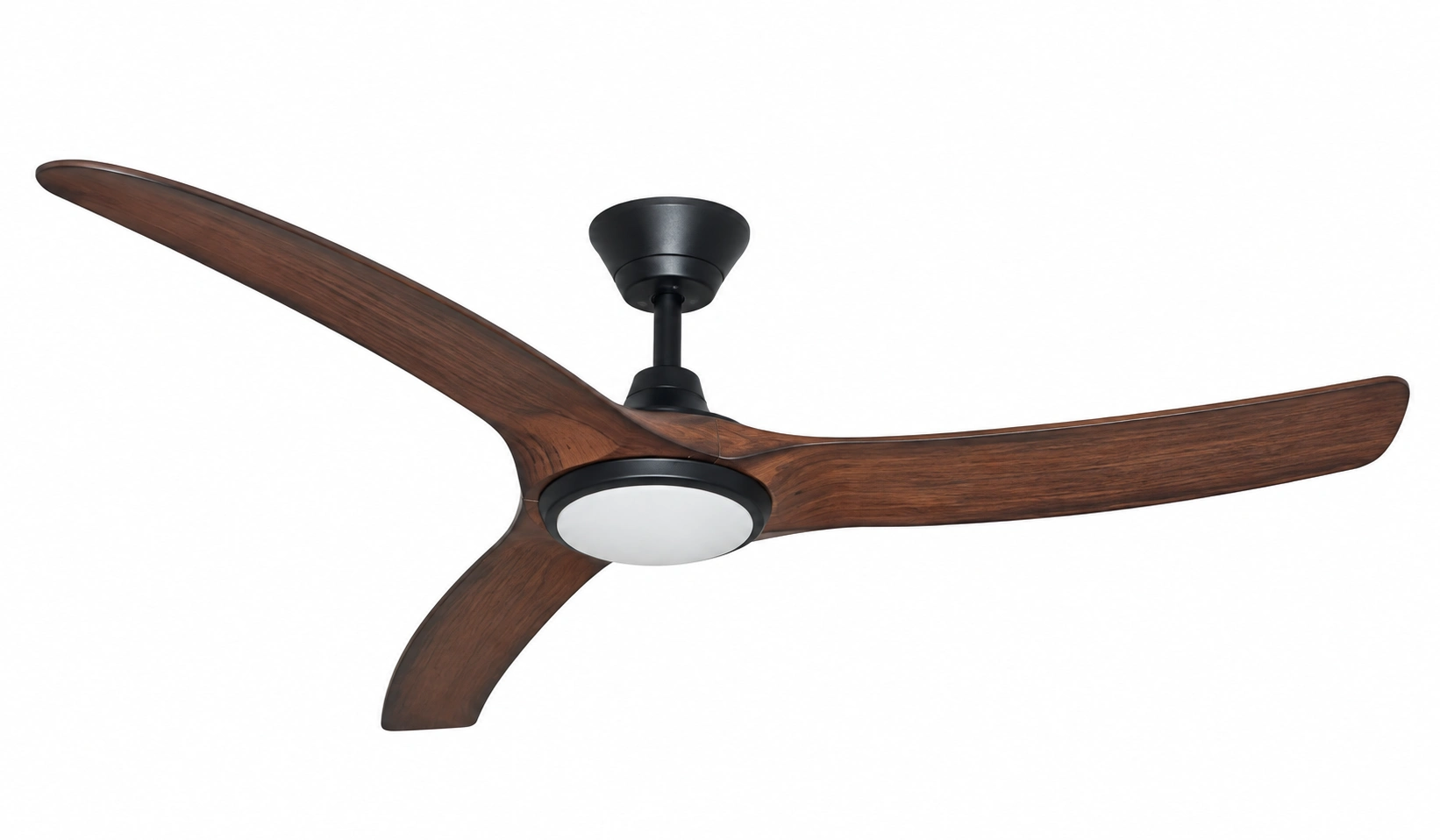
This is where blade pitch and motor pairing really show their value. The Calisto 132cm by Lumos, for instance, pairs a DC motor with its blade design to deliver 6,639 CFM while drawing just 19W, showing how well-matched blade and motor engineering can outperform raw size alone.
Figures like that better guide real-world performance than blade span alone, especially when comparing outdoor ceiling fan built for exposed patios or terraces.
Blade Design as Architecture: Aesthetics and Proportion
Blade design affects how the fan looks in a room, which is where it starts to behave more like architecture than an appliance.
A fan with a small blade count and slim, tapered blades tends to disappear into a minimalist ceiling, while a wider-bladed, more sculptural design can act as a genuine focal point in an open-plan space.
This is really a question of proportion: the blade span, pitch and finish all need to sit comfortably within the scale of the room, not just perform well within it.
Common Mistakes in Choosing Blade Design
A handful of avoidable mistakes account for most disappointing fan purchases. Here are some ceiling fan blade design mistakes:
- Choosing blade span based on ceiling size rather than floor area
- Assuming more blades always means more ceiling fan airflow
- Picking wood blades for a fully exposed outdoor location
- Ignoring motor type and focusing on blade size alone
- Overlooking blade pitch when comparing CFM figures
- Choosing a design purely on looks without checking it suits the room's proportions
Getting Blade Design Right for Your Space
Blade design is easy to overlook when it works well and impossible to ignore when it doesn't. The span, pitch, material, and proportion of a fan are what make it different from one that just spins and one that really belongs in the room. At Dubai Ceiling Fan, we offer designs that balance performance, comfort, and style, whether you're looking for a quiet, wood-bladed fan for your bedroom or a high-CFM outdoor model for a Dubai terrace.
Frequently Asked Questions
What makes a good ceiling fan blade design?
A good design balances blade span, pitch, and material to the room it's cooling, paired with a motor strong enough to perform as intended rather than just look the part.
Does fan blade design affect airflow?
Yes. Span, pitch, shape and blade count all directly influence how much air a fan moves, often more than the motor's raw power alone.
Are more ceiling fan blades better?
Not necessarily. Extra blades add drag, so a well-engineered three- or four-blade fan frequently outperforms a five- or six-blade design that wasn't built to handle the added load.
What is the ideal ceiling fan blade angle?
A pitch of 12 to 15 degrees works best for most ceiling fans, but it depends on the motor type and blade shape. Steeper pitches move more air per rotation, but they also put more stress on the motor.
Does blade size affect ceiling fan performance?
Yes, but only if it's the right size for the room and has the right motor. An oversized fan in a small room feels too loud, and an undersized fan in a large room won't move the air around well.
Display prices in:AED
